
Following the historic Meltdown and Spectre hardware vulnerabilities, security researchers uncovered a dangerous family of speculative execution flaws impacting Intel microprocessors known as Microarchitectural Data Sampling (MDS)—popularly codenamed ZombieLoad, RIDL, Fallout, and MDSUM. These vulnerabilities allow local unprivileged users, malicious applications, or rogue virtual machine tenants to leak sensitive data (such as encryption keys, system passwords, and browser sessions) directly from internal CPU microarchitectural buffers without requiring elevated administrator privileges.
This technical advisory breaks down the four recognized MDS attack vectors, explains how hardware speculative execution buffers leak data, and details step-by-step mitigation commands for Linux (Ubuntu, Debian, AlmaLinux, RHEL) and Windows Server (2025, 2022, 2019, 2016) on cloud VPS and dedicated infrastructure.
The four CVE vulnerabilities under MDS explained
MDS exploits internal temporary hardware structures situated between CPU L1 data caches and core registers:
- 1. Microarchitectural Fill Buffer Data Sampling (MFBDS / ZombieLoad / RIDL) — CVE-2018-12130:
Attackers exploit the Line Fill Buffer (LFB) used to track data moving between CPU caches. Malicious threads can sample un-associated fill buffer entries containing recently processed secrets from other virtual machines or processes.
- 2. Microarchitectural Store Buffer Data Sampling (MSBDS / Fallout) — CVE-2018-12126:
Exploits CPU Store Buffers that hold store operations before writing them to L1 cache. Low-privileged threads can read in-flight pipeline store data.
- 3. Microarchitectural Load Port Data Sampling (MLPDS) — CVE-2018-12127:
Allows data sniffing from CPU Load Ports that fetch data from memory into processor registers.
- 4. Microarchitectural Data Sampling Uncacheable Memory (MDSUM) — CVE-2018-11091:
Leaks data from memory regions designated as uncacheable (UC) directly from internal pipeline buffers.
How to check if your Linux server is vulnerable to MDS
Modern Linux kernels report hardware mitigation status directly through the sysfs vulnerability interface:
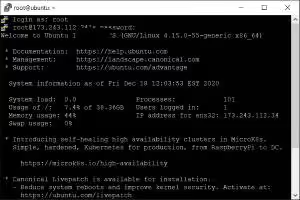
- Connect to your server via SSH.
- Check the kernel MDS mitigation status:
cat /sys/devices/system/cpu/vulnerabilities/mds - Interpreting the output:
Mitigation: Clear CPU buffers; SMT disabledorMitigation: Clear CPU buffers; SMT mitigated$\rightarrow$ Protected.Vulnerable: Clear CPU buffers attempted, no microcode$\rightarrow$ Requires immediate microcode / kernel update.Not affected$\rightarrow$ Your CPU architecture is immune.
How to apply MDS mitigations on Linux (Ubuntu, Debian, AlmaLinux)
MDS mitigation requires a two-step approach: updating Intel microcode and running updated kernel packages with buffer clearing instructions (MD_CLEAR).
On Ubuntu and Debian:
sudo apt update && sudo apt install intel-microcode -y
sudo apt dist-upgrade -y
sudo reboot
On AlmaLinux, Rocky Linux, and RHEL / CentOS:
sudo dnf install microcode_ctl -y
sudo dnf upgrade -y
sudo reboot
How to apply MDS mitigations on Windows Server and Windows 10/11
Microsoft released cumulative security rollups (ADV190013) that deploy software mitigations and CPU buffer clearing logic:
- Run Windows Update and install all pending Cumulative Quality Rollups.
- Verify mitigation state via PowerShell using Microsoft’s official SpeculationControl module:
Install-Module -Name SpeculationControl -Force Get-SpeculationControlSettings - Ensure
MDSWindowsSupportEnabledandMDSWindowsSupportPresentboth return True.
Cloud and hypervisor isolation at Aminserve
On shared multi-tenant infrastructure, Simultaneous Multi-Threading (SMT / Hyper-Threading) without kernel mitigations can allow cross-thread cache snooping. At Aminserve, all enterprise hypervisors apply hardware-level microcode patches, core scheduling, and strict memory isolation to guarantee complete tenant security.
For dedicated hardware, mission-critical isolation, and high-performance computing, explore Aminserve Linux & Windows VPS and Dedicated Server Hosting backed by 24/7 technical support.