By default, the Secure Shell daemon (sshd) on Linux servers listens on TCP port 22. Because port 22 is globally standard, exposed servers face relentless automated password brute-force and dictionary attacks from internet botnets. Attackers scan public subnets 24/7, bloating your authentication log files (/var/log/auth.log or /var/log/secure) and consuming server CPU resources.
Changing your default SSH port to a non-standard port (such as 2222, 22222, or any custom port above 1024) eliminates over 98% of automated scanner noise. This step-by-step guide explains how to change the SSH port on Ubuntu, Debian, CentOS, AlmaLinux, and Rocky Linux without locking yourself out.
Safety checklist: Preventing SSH lockouts
- Keep your current SSH session open: Never close your existing SSH terminal window until you have verified that a new terminal can connect over the new port.
- Configure firewall rules BEFORE restarting SSH: Opening the new port in UFW, FirewallD, or iptables must be done before reloading the SSH service.
- Choose an unassigned high port: Pick a port between 1024 and 65535 (e.g.
22222or45822) that is not used by web, mail, or database servers. - SELinux Considerations (RHEL / CentOS / AlmaLinux): If SELinux is active (enforcing), you must inform SELinux of the new port using
semanage.
Step 1: Open the new port in your firewall FIRST
On Ubuntu / Debian (UFW):
sudo ufw allow 22222/tcp
sudo ufw reload
On CentOS / AlmaLinux / Rocky Linux (FirewallD):
sudo firewall-cmd --permanent --add-port=22222/tcp
sudo firewall-cmd --reload
On iptables:
sudo iptables -A INPUT -p tcp --dport 22222 -j ACCEPTStep 2: Update SELinux policy (RHEL / CentOS / AlmaLinux only)
If you run a Red Hat-family distribution with SELinux enabled, allow SSH to bind to the non-standard port:
# Check if SELinux is enforcing
sestatus

# If Enforcing, register the new port with SELinux:
sudo semanage port -a -t ssh_port_t -p tcp 22222

# If semanage is missing, install policycoreutils:
sudo dnf install policycoreutils-python-utils -y
Step 3: Edit the SSH configuration file
- Open the primary SSH daemon configuration in your preferred text editor:
sudo nano /etc/ssh/sshd_config - Locate the line containing
#Port 22near the top of the file. - Uncomment the line by removing the
#character, and change the value to your custom port (e.g.Port 22222):Port 22222 - Save the file (Ctrl + O, then Enter) and exit (Ctrl + X).
Step 4: Test configuration syntax and restart SSH
Before restarting the daemon, test the config file for syntax errors:
sudo sshd -tIf the test returns no output, your syntax is valid. Restart the SSH service using systemd:
# On Ubuntu / Debian:
sudo systemctl restart ssh

# On CentOS / AlmaLinux / Rocky Linux:
sudo systemctl restart sshd
Step 5: Verify connection BEFORE closing your terminal
Do NOT close your current terminal window! Open a separate, new terminal window on your local computer and test logging in with the -p flag:
ssh root@YOUR_SERVER_IP -p 22222If you log in successfully, you can now safely close port 22 on your firewall and close your old terminal session:
# On UFW:
sudo ufw delete allow 22/tcp

# On FirewallD:
sudo firewall-cmd --permanent --remove-service=ssh
sudo firewall-cmd --reload
Emergency rescue: What to do if locked out?
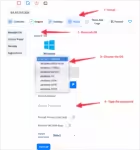
If you made a typo or your firewall blocked the connection, you can regain control in seconds via the Aminserve Client Portal using our out-of-band VNC Console. See our step-by-step VNC Console emergency rescue guide.